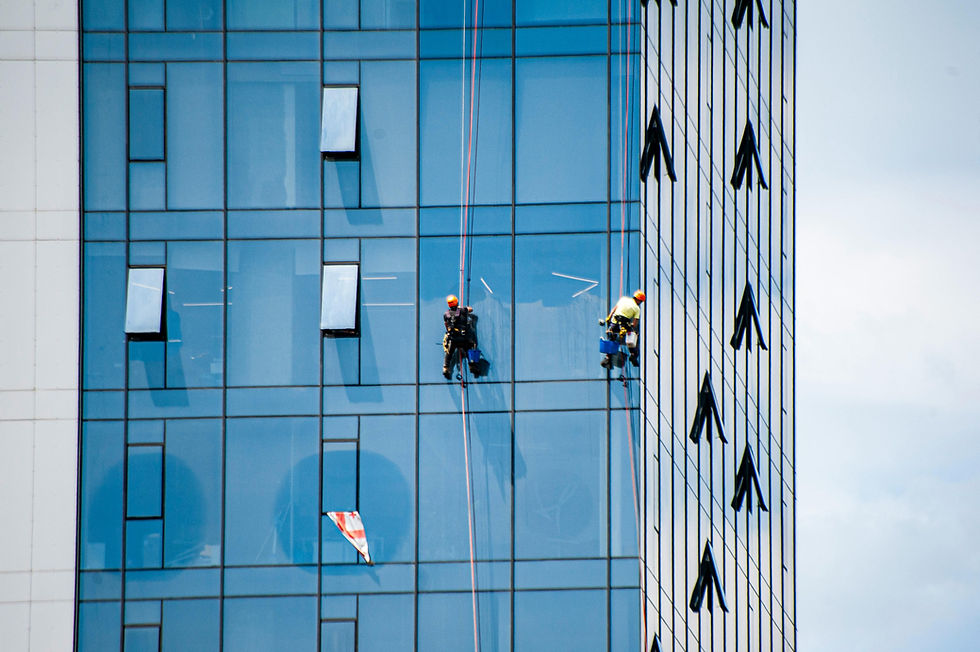
Facade Cleaning via Rope Access
Updated: Jun 6
Facade Cleaning & Maintenance
Maintaining the exterior of high‑rise and complex buildings is a critical aspect of asset management, compliance, and long‑term structural integrity. Facade cleaning not only enhances aesthetic appeal but also prevents deterioration caused by environmental pollutants, weathering, and biological growth. For building owners and facilities managers, establishing a structured, proactive maintenance programme is no longer optional - it is a fundamental obligation.
At the heart of this approach lies the Annual Maintenance Contract (AMC), a formal service agreement that ensures regular, scheduled facade cleaning and inspection by qualified specialists. Combined with the precision, flexibility, and safety of rope access methods as the primary access strategy, and supported by Building Facade Management (BFM) practices, an AMC delivers a comprehensive, cost‑effective solution for sustaining the performance and appearance of high‑rise facades.
The Case for an Annual Maintenance Contract (AMC)
An Annual Maintenance Contract provides building owners and managers with a structured framework for facade upkeep, replacing ad hoc service calls with a planned, proactive regime. Under an AMC, cleaning frequencies, inspection intervals, access methodologies, and compliance documentation are all agreed upon in advance, giving stakeholders full visibility over maintenance activities and associated costs.
The financial advantages of an AMC are significant. By committing to a scheduled programme, building managers avoid the premium costs associated with reactive maintenance and emergency interventions. Facade deterioration - whether from salt‑laden coastal air, industrial pollutants, or biological growth - compounds over time when left unaddressed. An AMC arrests this cycle by ensuring that cleaning and minor remediation work is carried out at regular intervals, extending the service life of cladding, glazing, and sealant systems.
From a compliance perspective, an AMC provides the documentary trail required for regulatory inspections and due diligence audits. Each service visit generates a formal record of work completed, access methods employed, and any defects identified, creating a comprehensive maintenance history that supports asset valuation and insurance requirements.

Rope Access vs BMU: Choosing the Right Primary Method
The delivery of facade cleaning and maintenance services at height demands access solutions that are safe, efficient, and minimally disruptive to building occupants and the surrounding environment. Rope access methods, governed by IRATA standards, have become the preferred methodology for high‑rise facade work across Australia and internationally, particularly where owners want reliability and coverage across complex geometry.
By contrast, many buildings rely on a Building Maintenance Unit (BMU) - cradles, davit systems, or gondola rigs - as the default access solution. BMUs are complex mechanical assets that require regular inspection, load testing, and certification to remain compliant. When a BMU falls out of certification due to deferred maintenance, mechanical failure, outdated components, or expiring statutory inspections, the building’s primary means of facade access can be removed from service for weeks or months.
The hidden risk of BMU dependence:
A tagged‑out BMU does not simply create an inconvenience - it creates a maintenance vacuum. Cleaning cycles are missed, sealant inspections are deferred, and minor defects that would ordinarily be identified and remediated during routine access visits are left to progress undetected. Water ingress, accelerated cladding deterioration, and sealant failure can all develop in the period a BMU remains out of service, turning low‑cost preventive maintenance into major remedial works, and in some cases, introducing safety risks to occupants and the public.
Rope access as the primary, BMU as the support:
This is precisely where rope access should be positioned as the primary access methodology, with the BMU used as a secondary tool where it genuinely adds value.
Rope access is largely independent of the building’s mechanical access infrastructure, requiring only certified anchors and a compliant rigging configuration.
Technicians operate on a twin‑rope system, one working line and one independent safety line, providing continuous fall protection and eliminating the need for scaffolding or elevated work platforms in most scenarios.
Mobilisation is fast; teams can be on site and operational within hours, making it practical to schedule higher‑frequency, shorter visits under an AMC.
Where a BMU is operational and compliant, it can still be integrated into the strategy - for example, as a materials lifting aid or as a working platform for specific facade zones - but it no longer represents a single point of failure for facade maintenance.
Why Rope Access Excels on Complex Facades
The versatility of rope access methods makes them particularly well suited to modern architectural forms. Curved curtain walls, recessed glazing, textured cladding, and intricate facade detailing that would be difficult or impossible to reach via conventional access equipment, including a functioning BMU, are readily accessible to rope access technicians. Gondola‑based systems are constrained by their travel paths and cannot always reach inset or angled elements; rope access technicians, by contrast, can position themselves precisely where they are needed.
This capability is especially valuable in the context of an AMC, where consistent, thorough cleaning and inspection across the entire facade is essential to maintaining uniform appearance and preventing localised deterioration. Whether the building’s BMU is operational, under repair, or permanently decommissioned, an AMC underpinned by rope access methodology ensures that facade care is never compromised.
Safety is central to all rope access operations. Adherence to structured work‑rest cycles, fatigue management protocols, and site‑specific rope access rescue planning is embedded within Veraspec’s service delivery. All Veraspec rope access personnel hold current IRATA certification, and every operation is supported by detailed risk assessments and rescue plans prepared in advance of mobilisation

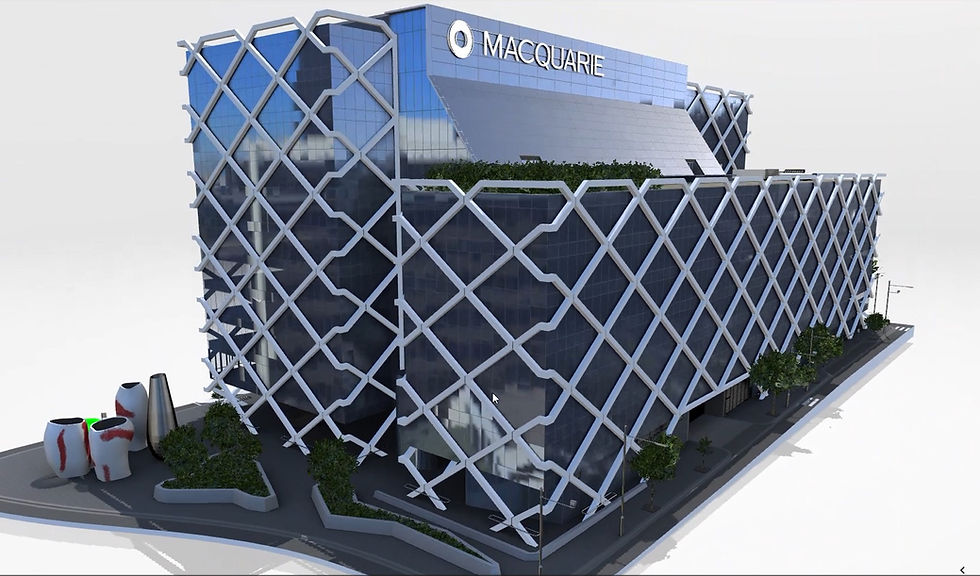
3D Building Facade Management (BFM): Turning Data into Strategy
While physical access is critical, the long‑term performance of the facade depends on how inspection and maintenance data is captured, analysed, and acted upon. This is where Building Facade Management (BFM) comes into play.
BFM is a disciplined, data‑driven approach that consolidates:
Close‑proximity findings captured by rope access technicians (defects, sealant failures, water ingress pathways).
Maintenance history and AMC service records.
Material performance, environmental exposure data, and previous remediation works.
By housing this information in a structured facade management framework or digital platform, building managers gain a clear view of condition trends, recurring issues, and emerging risks. This allows them to:
Prioritise high‑risk zones in upcoming rope access campaigns.
Plan targeted remediation instead of broad, reactive works.
Inform capital planning with evidence‑based lifecycle projections.
In this way, rope access becomes the execution arm of the BFM strategy, while the AMC provides the contractual and scheduling structure that keeps the whole system moving.
Rethinking Drone Inspections
Drone technology has been heavily promoted in recent years as a solution for facade inspection. In practice, its usefulness on occupied, high‑rise buildings is often constrained by:
Regulatory requirements and airspace/flight restrictions in dense urban environments.
Line‑of‑sight limitations and image quality challenges in strong sunlight or reflective glazing conditions.
Difficulty in reliably identifying fine defects - such as hairline cracks, sealant pinholes, or subtle panel displacement - from a standoff distance.
As a result, drone footage can be a useful supplementary tool for broad visual context - for example, capturing general elevations or validating access planning - but it is not a substitute for close‑proximity inspection conducted by trained rope access technicians. For detailed defect mapping, measurement, and verification, rope access remains the more accurate and actionable method.
In a best‑practice model, BFM integrates:
Rope‑access‑based condition assessments for close‑range detail.
Selected aerial or ground‑based imagery where permitted and genuinely helpful.
A structured AMC regime to turn these insights into planned work packages.
This combination removes over‑reliance on drones while still leveraging technology where it adds real value.
Operational Efficiency Through Structured Rope Access Planning
A well‑structured AMC, delivered predominantly via rope access, significantly optimises operational efficiency for building management teams. By establishing a fixed maintenance calendar at the outset of the contract, facilities managers can coordinate facade cleaning with other building services activities, minimising disruption and ensuring that access arrangements are planned well in advance.
Because rope access mobilisation is efficient, maintenance can be broken into smaller, more frequent visits rather than monolithic, once‑a‑year campaigns. This allows cleaning intervals to be tuned to the building’s exposure, occupancy patterns, and facade material requirements - for example, more frequent attention to heavily soiled podium levels and coastal elevations.
Each service visit under an AMC is supported by detailed documentation, including method statements, risk assessments, rope access rescue plans, and post‑works reports. This ensures that building management, the rope access team, and compliance officers all have immediate access to the information required for safe and efficient service delivery.
Practical Guidance for Building Managers and Asset Custodians
Building managers and asset custodians seeking to establish or review their facade maintenance programme should consider the following recommendations.
Engage a specialist early.
The scope and frequency of facade cleaning under an AMC should be determined through a thorough initial inspection by a qualified facade specialist. This assessment identifies facade materials, access challenges, contamination levels, and existing defects that will inform the maintenance programme design and the rope access/BMU balance.
Define service requirements clearly.
An effective AMC specifies the cleaning and inspection methods appropriate to each facade element, the rope access configuration for each zone, and the limited, clearly defined roles for any BMU involvement. Clear definition at contract stage prevents ambiguity during service delivery.
Integrate inspection with cleaning.
Rope access technicians are uniquely positioned to conduct close‑proximity inspections during cleaning visits, identifying sealant failures, cladding fixing concerns, glazing defects, and water ingress pathways that would not be visible from the ground or from drone imagery. Incorporating this inspection function into the AMC maximises the value of each visit and directly feeds your BFM strategy.
Maintain a comprehensive service record.
Every visit should generate a formal report documenting work completed, areas of concern, photographic evidence, and recommendations. This record becomes the backbone of your BFM data set and is essential for compliance, insurance, and long‑term asset planning.
Review and adapt annually.
At the conclusion of each contract year, review the AMC and BFM data in light of the facade’s observed performance, any incidents, and changes in building use or environment. Adjust cleaning frequencies, rope access deployment patterns, and any BMU or technology integrations accordingly.
Sustaining Building Performance Through Expert Facade Care
Effective facade maintenance is a cornerstone of building longevity, occupant safety, and regulatory compliance. An AMC, delivered primarily by qualified rope access specialists and structured within a Building Facade Management framework, provides building owners and managers with the proactive approach required to protect their assets and uphold their obligations.
By establishing a planned maintenance regime, prioritising rope access over mechanical dependence, integrating detailed inspection into every visit, and maintaining rigorous service documentation, stakeholders can ensure that their building’s facade performs to the highest standard throughout its service life. Veraspec brings deep technical expertise, IRATA‑certified rope access capability, and a commitment to precision and professionalism to every AMC engagement - whether your building presents a straightforward curtain wall or a complex, architecturally distinctive facade.