
Annual Facade Maintenance Contracts: The Foundation of Facade Health
Updated: Jun 6
For facilities managers and building owners across Australia and the UAE, the exterior of a high-rise tower is more than just an aesthetic feature - it is the primary line of defence against harsh environmental conditions. Yet, too often, facade maintenance is reduced to a simple cleaning schedule. In this article, we explore why an Annual Maintenance Contract (AMC) must go beyond the wash to deliver comprehensive facade care, preventative maintenance, and long-term structural integrity.
Maintaining the exterior of high-rise and complex buildings is a critical aspect of asset management, compliance, and long-term structural integrity. While facade cleaning undoubtedly enhances aesthetic appeal, its true value lies in preventing the deterioration caused by environmental pollutants, weathering, and biological growth. For building owners and facilities managers, establishing a structured, proactive maintenance programme is no longer optional - it is a fundamental obligation.
At the heart of this approach lies the Annual Maintenance Contract (AMC). However, a modern AMC is far more than a simple cleaning agreement. It is a formal service framework that ensures regular, scheduled facade cleaning, rigorous inspection, and preventative maintenance by qualified specialists. When combined with the precision of rope access methods and digital defect management, an AMC delivers a comprehensive, cost-effective solution for sustaining the performance and appearance of high-rise facades.
The Case for a Comprehensive AMC
An Annual Maintenance Contract provides building owners and managers with a structured framework for facade upkeep, replacing ad hoc service calls with a planned, proactive regime. Under a robust AMC, cleaning frequencies, inspection intervals, access methodologies, and compliance documentation are all agreed upon in advance. This gives stakeholders full visibility over maintenance activities and associated costs.
The financial advantages of an AMC are significant. By committing to a scheduled programme, building managers avoid the premium costs associated with reactive maintenance and emergency interventions. Facade deterioration compounds over time when left unaddressed. An AMC arrests this cycle by ensuring that cleaning and minor remediation work - such as sealant replacement or cladding panel adjustments - are carried out at regular intervals, extending the service life of the building envelope.
From a compliance perspective, an AMC provides the documentary trail required for regulatory inspections and due diligence audits. Each service visit generates a formal record of work completed, access methods employed, and any defects identified, creating a comprehensive maintenance history that supports asset valuation and insurance requirements.
Regional Challenges: Australia vs. the UAE
The necessity of a proactive AMC becomes even more apparent when considering the specific environmental challenges faced by high-rise buildings in different regions. Veraspec operates extensively across both Australia and the United Arab Emirates, and while the core principles of facade care remain the same, the environmental stressors dictate tailored maintenance strategies.
Australia: Coastal Proximity and UV Degradation
In Australian cities like Sydney, Melbourne, and the Gold Coast, the primary threats to facade health are coastal proximity and intense ultraviolet (UV) radiation.
Chloride Attack: Fine salt particles carried by sea breezes settle on building facades and slowly work their way into concrete and porous stone. Once these chlorides reach steel reinforcement, they break down its natural protective layer, initiating corrosion and subsequent concrete spalling. UV Degradation: Australia's high UV index accelerates the breakdown of silicone sealants, gaskets, and architectural powder coatings (governed by standards such as AS 3715).
An effective AMC in Australia must therefore prioritise regular washing to remove salt deposits before they can penetrate the substrate, alongside close-range inspections of sealants and glazing surrounds (in accordance with AS 1288) to identify UV-induced shrinkage or debonding.
The UAE: Extreme Heat and Particulate Abrasion
In the UAE, including Dubai and Abu Dhabi, the building envelope faces a different set of extreme conditions.
Thermal Expansion: The extreme temperature fluctuations between day and night cause significant thermal expansion and contraction in curtain wall systems and cladding panels. This constant movement places immense stress on structural sealants and expansion joints. Sand and Dust: Frequent sandstorms act as an abrasive force, dulling glass and degrading protective coatings. Furthermore, fine dust accumulates in drainage channels and weep holes, which, if not cleared, can lead to water ingress during the rare but heavy winter rains.
In the UAE, an AMC must focus on the integrity of movement joints, the clearing of drainage systems, and the use of appropriate, non-abrasive cleaning methods to protect glass and metal finishes. Compliance with local regulations, such as the Dubai Municipality facade cleaning regulations and ESMA standards for curtain walls, is also a critical component of the facade maintenance programme.
Integrating Inspection with Facade Maintenance
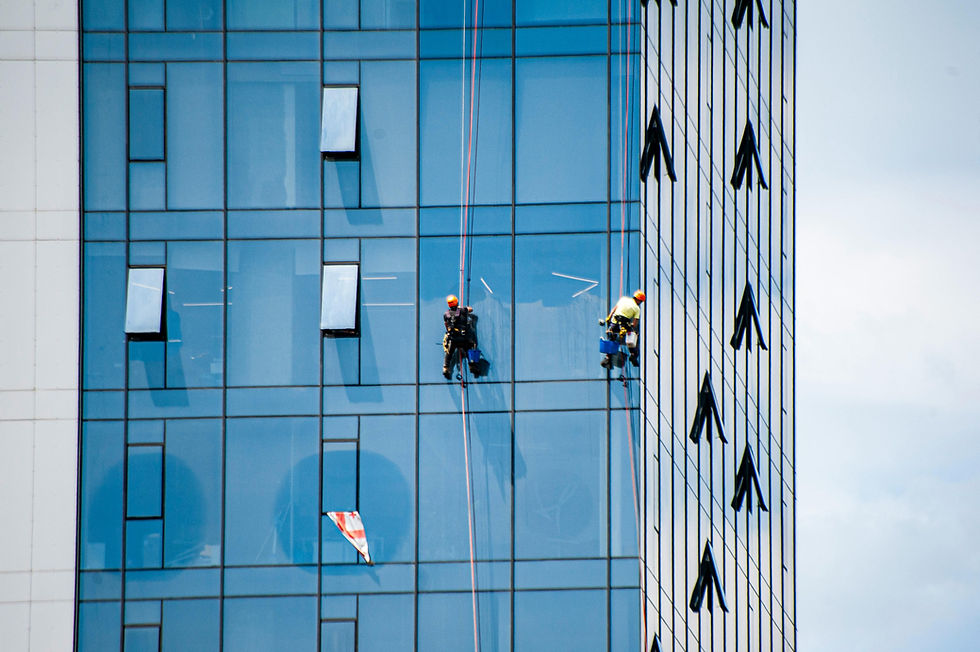
The most significant advantage of a comprehensive AMC is the integration of physical inspection with routine cleaning. While drone photogrammetry and LiDAR scanning offer valuable facade-wide context, they have documented limitations, particularly on glass-heavy facades where reflections and safe standoff distances obscure fine defects.
For operational facade maintenance, a physical inspection remains the most productive and reliable approach. It delivers conclusive assessments at the point of access rather than relying on remote interpretation. Rope access technicians are uniquely positioned to conduct close-proximity facade inspections during cleaning visits. They can identify sealant failures, cladding fixing concerns, glazing defects, and water ingress pathways that would not be visible from the ground or via drone imagery.
Incorporating this inspection function into the AMC maximises the value of each visit and supports a predictive maintenance model. Furthermore, it provides the critical ability to make-safe any high-risk issues immediately - such as loose elements or failing glass - addressing immediate safety concerns while technicians are on site.
The Role of Digital Facade Management
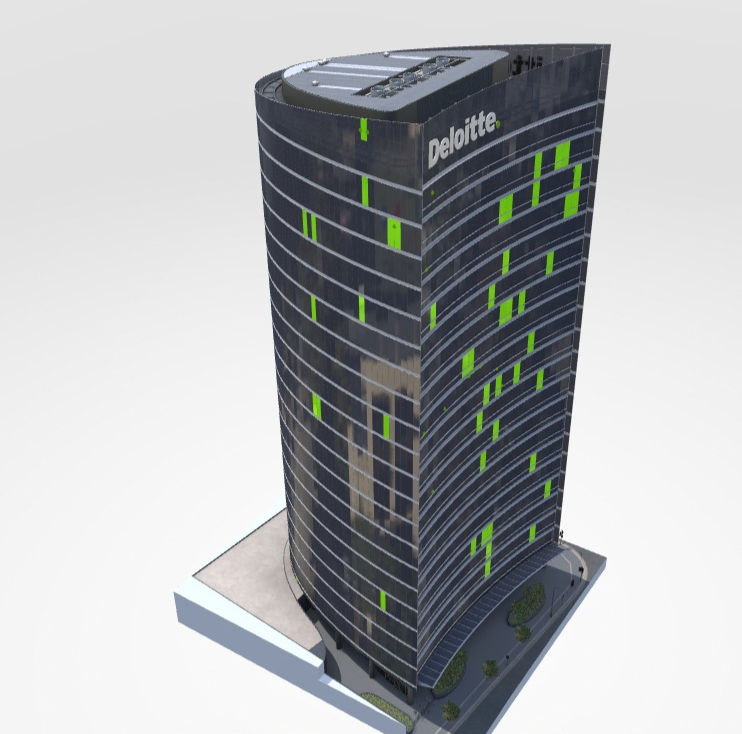
The data gathered during these integrated cleaning and inspection visits is only valuable if it is effectively managed. This is where digital facade management platforms, such as Veraspec's Building Facade Manager (BFM), become indispensable.
BFM centralises contractor completion evidence, timestamps, and repaired-defect logs. It ensures that once defects are identified, the close-out and safety record is operationally robust. By mapping defects onto a 3D model of the building, facilities managers can track deterioration trends over time, coordinate repair workflows, and maintain a historical record that supports future maintenance forecasting and capital planning.
Rope Access: The Agile Solution
The delivery of facade cleaning and maintenance services at height demands access solutions that are safe, efficient, and minimally disruptive. Rope access methods, governed by IRATA standards, have become the preferred methodology for high-rise facade work.
A common challenge for building managers is dealing with a Building Maintenance Unit (BMU) that is tagged out of compliant use due to mechanical failure or expired certification. A tagged-out BMU creates a maintenance vacuum where cleaning cycles are missed and minor defects progress undetected.
Rope access provides an indispensable solution. It is entirely independent of the building's installed access infrastructure, requiring only certified anchor points. Rope access mobilisation is inherently efficient; a team can be on-site and operational within hours, making it practical to schedule multiple short-duration visits throughout the year in alignment with an AMC.
Conclusion: Protecting Your Asset
Effective facade maintenance is a cornerstone of building longevity, occupant safety, and regulatory compliance. An Annual Maintenance Contract, delivered by qualified specialists, provides building owners and managers with the structured, proactive approach required to protect their assets.
By moving beyond simple cleaning to embrace integrated inspection, digital defect management, and agile rope access delivery, facilities managers can ensure that their building's facade performs to the highest standard throughout its service life - whether facing the coastal salt of Sydney or the extreme heat of Dubai.
To discuss a comprehensive Annual Maintenance Contract for your building, contact the Veraspec team today.

