Rope Access vs Scaffolds and BMUs: Choosing the Right Facade Access
Why rope access makes sense for modern facade work
For many property and facility managers, the default assumption is that serious facade work needs serious access: scaffolding, cranes, or a building maintenance unit (BMU). Those methods still have their place, but on many high‑rise assets they are no longer the most practical, efficient, or cost‑effective option. Rope access offers a different approach to cleaning, glazing, inspections and other facade works – one that reduces disruption while maintaining very high safety standards.
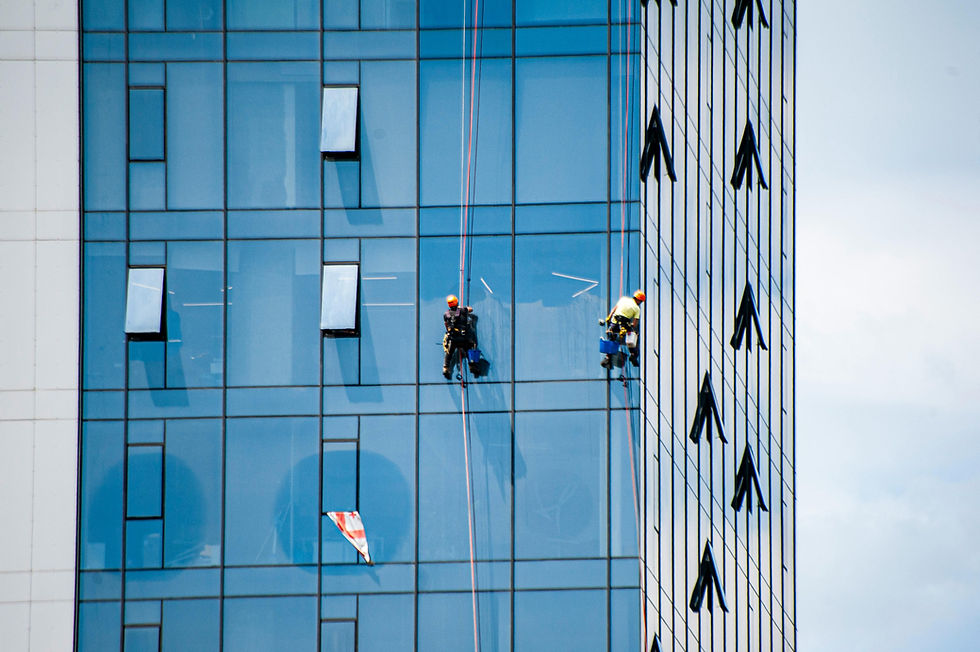
Rope access technicians use specialist equipment and work positioning techniques, anchored back to the structure, to reach almost any external or internal facade area. Because the system is light and flexible, setup can often be completed in hours, not days or weeks. For an asset team managing live buildings, this can be the difference between a targeted, low‑visibility operation and a highly disruptive project that tenants notice for all the wrong reasons.
Safety and IRATA standards
A common misconception is that rope access is “riskier” because technicians are suspended on ropes rather than a large structure. In reality, professional rope access work is tightly governed by international standards, with IRATA International (Industrial Rope Access Trade Association) being the most widely recognised scheme globally. IRATA’s system requires technicians to complete formal training, log a minimum number of hours at each level, and undergo regular reassessment to maintain their certification.
There are three main IRATA levels. Level 1 technicians are trained operators working under supervision, Level 2 technicians have additional rigging and rescue capabilities, and Level 3 technicians are advanced supervisors responsible for job planning, risk assessment, rigging design and on‑site safety management. This tiered structure means that a rope access team brings not just physical capability, but a formal framework for supervision, rescue planning and quality control. For building owners and managers, that translates into a clear, auditable standard of safety practice rather than ad‑hoc “working at height”.
Comparing rope access with scaffolding
Scaffolding can be appropriate for long‑duration projects with heavy material handling or very large areas of facade replacement. However, it also brings significant complications. Erection and dismantling can take days or weeks, often requiring lane closures, permits, staging areas and out‑of‑hours work. The scaffold itself can obstruct entrances, shopfronts and signage, and in some cases introduces additional security and public safety concerns.
Rope access, by contrast, typically requires much less ground‑level footprint. Technicians can mobilise from roof level or discrete anchor points, with minimal impact on pedestrians, traffic or retail tenancies. For cleaning, routine inspections, minor glazing replacements and localised repairs, the time and cost associated with a full scaffold can be disproportionate to the task. Rope access lets asset teams carry out those works quickly, often in narrower time windows, without turning the building into a construction site.

Rope access versus BMUs and cranes
BMUs are valuable where they exist and are well maintained, but they are not a complete solution. Coverage can be limited, especially on complex geometries, internal atria or recessed areas. BMUs may also be out of service for maintenance, or structurally incapable of supporting the loads required for certain glazing or remediation tasks. In those cases, rope access can supplement the BMU by reaching otherwise inaccessible zones, or by providing additional capability for more complex interventions.
Cranes, meanwhile, are highly effective for heavy lifts and major construction works but can be a blunt instrument for targeted maintenance. Mobilising a crane in a dense urban environment often involves traffic management, road closures, permits and significant preliminary planning. For a simple piece of facade glass or a localised remedial repair, the crane can easily become the most expensive part of the project. Rope access allows smaller elements to be installed, removed or repaired using specialist lifting techniques and devices without the same level of disruption to the surrounding streetscape and building operations.

Applications: cleaning, glazing, inspections and more
For facade cleaning, rope access offers a flexible way to cover large areas with minimal setup. Technicians can adjust routes in real time based on wind, sun, and building use, and can combine visual inspections with cleaning to identify early signs of deterioration or damage. This dual function can be particularly valuable for owners who want better condition data without scheduling separate, dedicated inspection campaigns.
In glazing, rope access enables safe replacement of many types of facade glass without full scaffold or large cranage, especially where the glass size and weight are compatible with rope‑based lifting solutions and internal handling. Coordinated correctly, technicians can remove failed units, manage temporary weatherproofing, and install new glass with controlled, pre‑planned lifting systems that are designed for work at height. Similar benefits apply to sealant remediation, localised cladding repairs, minor leak investigations and the installation of height safety components.

Cost, disruption and program
From a commercial perspective, rope access often reduces indirect costs rather than just headline rates. The direct day rate for an IRATA‑qualified team might not look radically different to other trades, but savings emerge in reduced setup and dismantle time, fewer permits, less disruption to tenants and public areas, and the ability to sequence work in shorter, more targeted visits. This flexibility can make it easier to align works with quiet periods, tenant requirements or specific weather windows.
Program risk is also lower in many scenarios. Because rope access systems can be established quickly and reconfigured as needed, the project is less exposed to delays associated with scaffold erection, crane availability, or BMU breakdowns. For property and facility managers who are judged on uptime, tenant experience and safety, that reduction in complexity can be as valuable as the direct cost savings.
Choosing the right method for your building
Rope access is not a universal replacement for scaffolding, BMUs or cranes. Heavy structural replacements, very large‑format glazing or extensive cladding change‑outs may still justify more traditional access methods. The real value lies in choosing the right tool for the job: using rope access for inspections, cleaning, smaller glazing works, leak investigations and localised remediation, and reserving more invasive methods for when they are truly warranted.
For owners and managers, the key questions become: What is the scope of work? How time‑sensitive is it? How much disruption can the building tolerate? And which combination of access methods will deliver the safest, most efficient outcome? An IRATA‑qualified rope access provider can help answer those questions, design a compliant access solution, and integrate rope access with other methods where appropriate.